
Terminology & compliance note. In the strict Singapore sense, “facade inspection” refers to Periodic Facade Inspection (PFI) — the statutory regime under the Building Control (Periodic Inspection of Buildings and Building Facades) Regulations 2021, administered by BCA. A statutory PFI must be planned, directed and certified by a registered Competent Person (CP) appointed by the building owner. Where this article uses “facade inspection” in a general sense, the statutory equivalent is PFI; ad-hoc surveys outside the regulations are properly described as facade condition checks or PFI support.
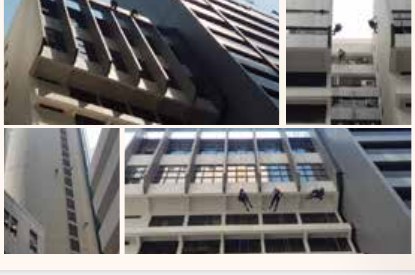
Our role. Facade Inspection Singapore (operated by Ezzogenics) is a Singapore work-at-height contractor. We provide close-range access support, rope-access / height-access support, visual and photographic documentation, tapping checks, defect recording, condition checks and repair / rectification support. We do not act as the appointed CP, nor do we independently certify PFI compliance or replace the CP, consultant or QP. Where statutory inspection is involved, our contractor support is coordinated under the CP / consultant / QP’s direction.
Singapore's tropical climate — persistent heat, intense UV exposure, frequent heavy rainfall, and high humidity year-round — creates conditions that accelerate facade deterioration across almost every building material type. Understanding the most common defect patterns helps building owners, facility managers, and MCSTs engage more effectively with their Competent Person, interpret inspection findings, and assess the urgency and scope of recommended rectification works.
This article describes the defect types most frequently encountered during facade inspections in Singapore, their typical causes, and the implications for building owners.
1. Tile Debonding and Spalling
Ceramic, homogeneous, and stone tiles applied to external facades are among the most common finishing materials in Singapore's housing and commercial building stock. Over time, the bond between tile, adhesive, and substrate can degrade.
How it develops: Thermal cycling causes differential expansion and contraction between the tile, adhesive layer, and backing substrate. Where movement joints are absent, inadequate, or have degraded, stress accumulates in the tile bond. Moisture ingress behind tiles — through cracked grout, failed sealants, or substrate porosity — accelerates bond deterioration. Adhesive carbonation, poor original workmanship, and use of materials not suited to exterior wet conditions further compound the problem.
What it looks like (and how it is detected): Early-stage debonding is not visible to the eye — it produces a hollow sound when the tile surface is tapped. This is why close-range tapping inspection is essential and cannot be substituted by visual observation alone. Advanced debonding may produce visible cracking at grout lines, tile edge lifting, or tile displacement.
Risk and urgency: Debonded tiles over pedestrian areas, entrance canopies, or public walkways present a falling hazard. Where hollow areas are found above walkways or areas of regular public access, the CP may classify these as requiring prompt attention rather than scheduled maintenance. Building owners should not assume that tiles which have not yet fallen are safe.
2. Spalling Concrete
Concrete spalling — the breaking away of surface concrete — is common in buildings constructed before the adoption of more durable concrete mixes and higher cover requirements.
How it develops: The primary cause in Singapore's climate is reinforcement corrosion. Where concrete cover is insufficient, or where cracks allow moisture and carbon dioxide to penetrate to the reinforcement depth, the steel bars begin to oxidise. Corrosion products occupy significantly greater volume than the original steel, generating internal pressure that fractures and dislodges the concrete cover. Chloride ingress (particularly in coastal locations) accelerates this process.
Indicators visible during inspection: Rust staining on concrete surfaces is often the first visible sign — indicating that corrosion is active behind the surface. Crack patterns running parallel to the reinforcement direction (corrosion cracking) and areas of sounding concrete (hollow to the tap) are key indicators. In advanced cases, spalled areas with exposed reinforcement bars are present.
Risk and implications: Concrete fragments can be substantial in size and weight. Spalling above accessible areas is a direct falling hazard. Beyond the immediate safety concern, active reinforcement corrosion is a progressive deterioration mechanism — it will worsen if not treated. Rectification typically involves concrete repairs using approved repair mortars and may require protective coating or impregnation treatment of adjacent areas.
3. Cracking in Rendered Surfaces
Cracking in external render is among the most common observations in Singapore facade inspections. Not all cracks carry the same significance — the pattern, location, width, depth, and propagation direction are what matter.
Crack types commonly observed:
| Crack Type | Typical Cause | |-----------|---------------| | Hairline map cracking | Render shrinkage during curing; shallow and generally cosmetic | | Pattern cracking following block joints | Settlement or thermal movement at masonry joints beneath render | | Diagonal cracks at wall openings | Differential settlement or structural deflection | | Horizontal cracks at floor slab interfaces | Differential movement between structural frame and infill wall | | Vertical cracks in long wall runs | Thermal or moisture expansion of brickwork |
What the CP will assess: The CP will examine crack width, assess whether cracks are active (still growing) or dormant, evaluate whether they penetrate through the render into the substrate, and assess whether any cracks indicate structural concern. Structural cracks — those affecting load-bearing elements — warrant referral to a PE for assessment of structural implications.
Building owner note: If cracks are observed at structural elements such as beams, columns, or transfer structures, these should be brought to the attention of a PE where required. Do not assume all cracking is cosmetic.
4. Sealant and Joint Failure
External sealants — at expansion joints, window perimeters, cladding panel interfaces, and service penetrations — are designed to accommodate movement while maintaining a weather-resistant seal. They have a finite service life.
How failure occurs: In Singapore's climate, UV degradation, thermal cycling, and constant wet-dry cycles cause sealants to harden, crack, debond from the substrate (adhesion failure), or develop cohesion failure (tearing within the sealant body). Poorly designed joint profiles with insufficient sealant depth, or sealants applied without a bond-breaker where required, are also common causes of premature failure.
What is found at inspection: Sealant cracking, surface chalking, debonding beads, missing sections of sealant, and evidence of water ingress through failed joints are routinely found during close-range inspection. Staining patterns on the facade below joint locations can indicate where sealant failure has been allowing water to track.
Implications: Failed sealant joints are a primary pathway for water ingress into the facade construction. Over time, this can drive tile debonding, render deterioration, reinforcement corrosion, and internal water damage. Proactive sealant replacement is significantly less costly than dealing with secondary damage from prolonged water ingress.
5. Cladding Panel Defects
External cladding systems — aluminium composite panel (ACP), fibre cement, GRC (glass-reinforced concrete), and natural stone panels — have their own characteristic failure modes.
Common defects include:
- Panel deformation or buckling: Often caused by thermal expansion in long runs of cladding without adequate allowance for movement.
- Fastener and anchor corrosion: Where fixings are inadequately protected against moisture exposure, corrosion can compromise the structural capacity of the anchorage system. This is typically only detectable during close-range inspection.
- Panel delamination (ACPs): Older aluminium composite panels — particularly those with polyethylene cores — may delaminate under prolonged thermal exposure. This should be reviewed with care given the known fire performance concerns associated with certain core materials.
- Surface coating failure: Anodised or PVDF coatings on aluminium panels can fail over time, leading to corrosion of the aluminium substrate.
- Sealant failure at panel interfaces: As described above — accelerated at panel joints due to higher movement volumes.
6. Parapet Walls, Soffits, and Secondary Elements
Parapet walls, canopy soffits, sun shading elements, planter boxes, and architectural fins are structurally secondary elements but often carry significant facades inspection significance — they are frequently in a more deteriorated state than the main facade planes, and their failure typically occurs over pedestrian areas.
Why they deteriorate faster: These elements are exposed to weathering on multiple faces, often receive less maintenance attention, and in the case of planter boxes, may be subject to ongoing moisture from irrigation that drives accelerated deterioration of the concrete and tile finishes.
What inspectors look for: Cracking, spalling, loose rendered sections, tile debonding, and evidence of corroded reinforcement in these elements are all priority findings given their location and fall height.
7. Facade Staining and Biological Growth
Staining is not in itself a structural defect, but it is a useful indicator of underlying conditions.
- Rust staining: Indicates corrosion of embedded steel or fixings. Its location can help map corrosion patterns across the facade.
- Efflorescence (white salt deposits): Indicates moisture movement through masonry or concrete, carrying dissolved salts to the surface. Often a sign of ongoing water ingress.
- Biological growth (algae, moss, mould): Common in Singapore's climate on north-facing or shaded elevations and in areas of poor drainage. Biological growth can trap moisture and accelerate material degradation beneath it. Heavily affected areas should be cleared before close-range inspection to allow proper surface assessment.
Acting on Inspection Findings
The defect types described above range from straightforward cosmetic maintenance to safety-critical conditions requiring prompt action. The CP's report will indicate the relative urgency of different findings, but building owners should be aware that some defects — particularly falling hazards over accessible areas — may require immediate protective measures rather than waiting for the full rectification programme to be tendered.
If your building's inspection report has identified any of the defect categories above, contact us to discuss assessment, access, and rectification options.
This article is educational background on façade inspection regimes in Singapore. In the strict statutory sense, "façade inspection" means Periodic Façade Inspection (PFI) — the legal requirement under BCA's Building Control (Periodic Inspection of Buildings and Building Façades) Regulations 2021, which must be planned, directed and certified by an appointed Competent Person (CP). Building owners should appoint the required CP under BCA's PFI regime. Facade Inspection Singapore (operated by Ezzogenics) provides contractor-level support — close-range access, rope/height-access, visual and photographic documentation, tapping checks, defect recording, and rectification works — under the CP, consultant or QP's direction where statutory inspection is involved. We do not independently certify statutory PFI compliance or replace the appointed CP unless that role is separately and explicitly agreed.