
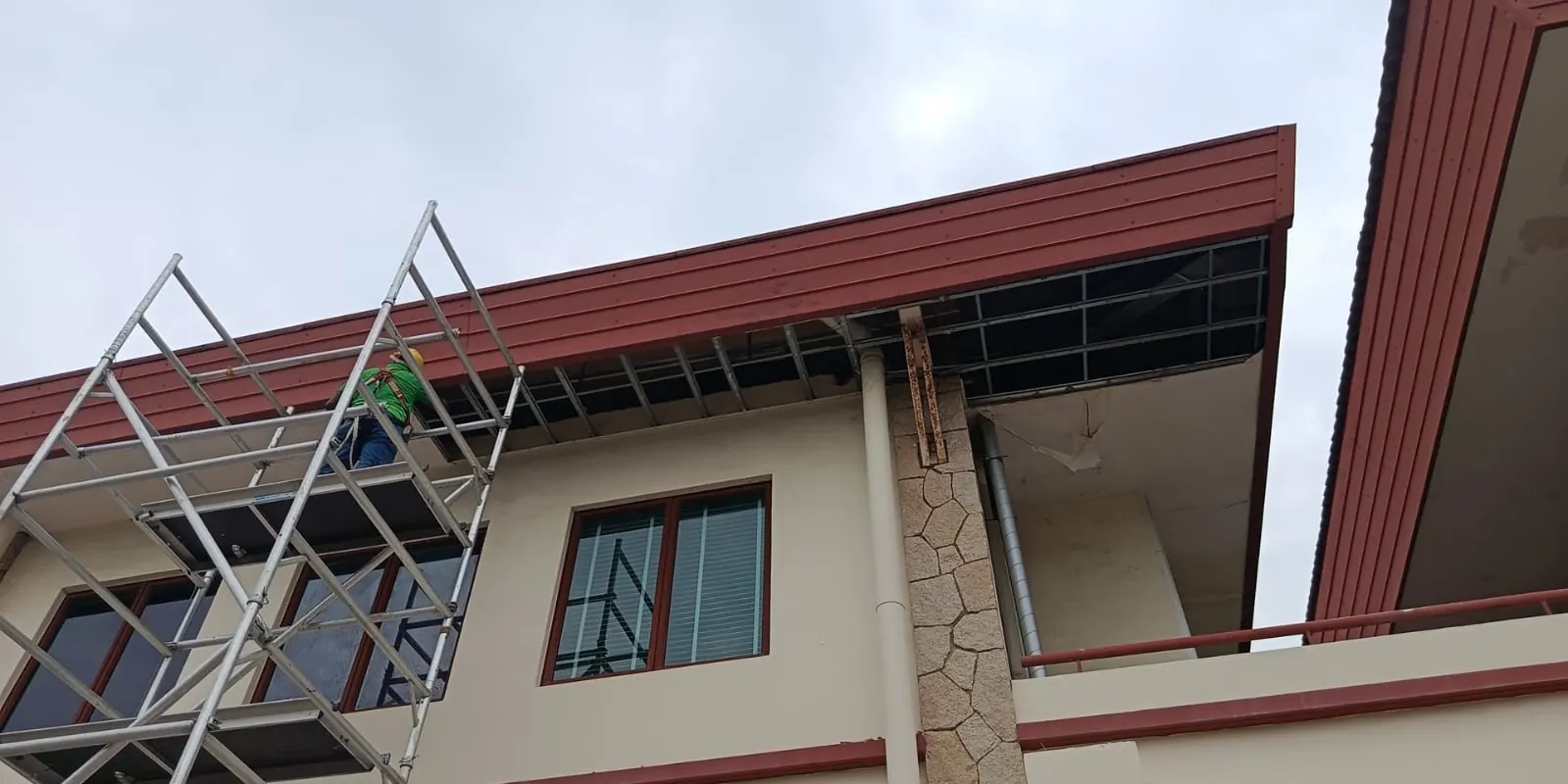
Build one evidence trail from the original defect to the finished location, authorised changes and any remaining action.
Direct answer: Agree the evidence pack before access is removed. Link every repair to its original defect ID, location, approved scope, concealed-work evidence, finished condition and open items.
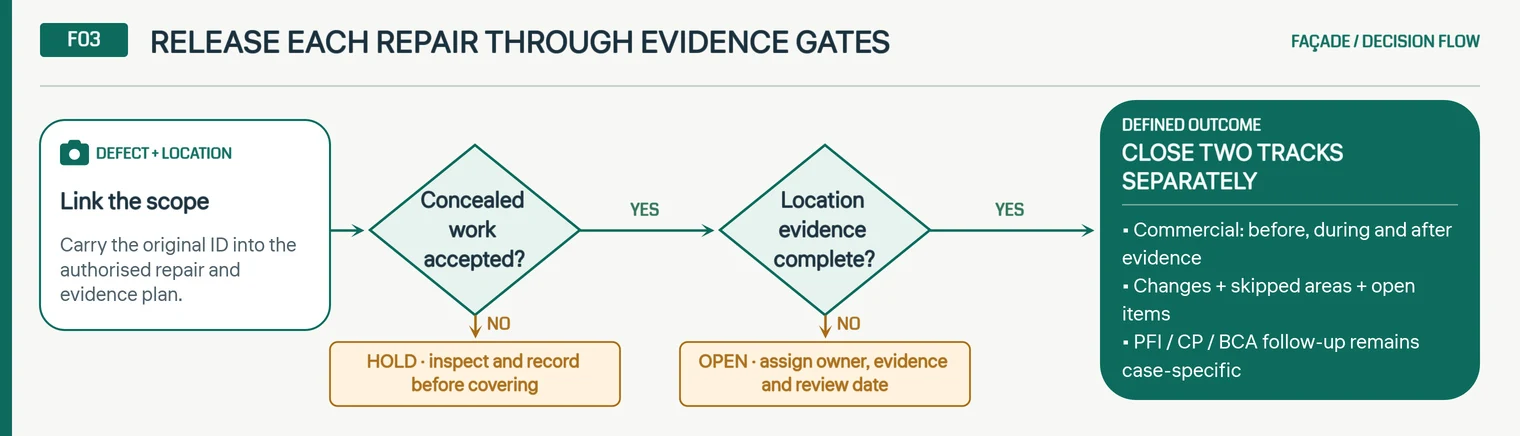
Set hold points while the work is still visible
At award, identify which locations require before, during and after photographs; which substrates, fixings, joints or preparation layers will be concealed; and who must inspect them. Specify any test, batch or product record that applies to the actual system. A hold point should name the reviewer, the evidence required and the release decision.
Schedule those reviews within the same access setup wherever practicable. This is recommended project-controls practice, not a universal statutory checklist. The CP, consultant and contract should determine what is necessary for the particular repair.
Make one location traceable end to end
A strong entry might read: ‘W-07 · west elevation · level 4 · between windows 04 and 05’. Link the original condition image, repair extent, dates, preparation and concealed-work photographs, applicable product or batch details, inspection acceptance and finished photograph. Attach the marked elevation and show any revised boundary rather than overwriting the original.
Where material, detail or quantity changed, link the authorised instruction and the person who accepted it under the contract. Use consistent filenames and a register that can be sorted by elevation, defect and work package. A folder of unsorted images is not an adequate retrieval system.
Close the commercial and statutory tracks separately
Sample the entries with the contractor and relevant consultant. Check that photographs are legible, locations match, excluded or skipped areas remain visible, and every open item has an owner and review date. For statutory PFI, ask the appointed CP which records or follow-up the case requires and comply with any BCA direction; commercial completion does not by itself settle that statutory track. BCA’s PFI page publishes a Completion of Remedial Works Report template among its resources for CPs, so ask the CP early whether it applies and what evidence it will need from the repair. [1] [2]
Practical checklist
- Link original defect, instruction, measurement and final photograph.
- Capture concealed details before the hold point is released.
- Record substitutions and the authority that accepted them.
- Carry skipped locations and unresolved exclusions into an open-items register.
Related reading
- How defects are located and photographed during inspection: façade defect mapping and photo records.
- When the measured extent changes: how to handle façade repair quantities that change once work starts.
- Records we prepare: façade inspection reports and defect mapping.
Scope of this article: Required tests, hold points and statutory submissions depend on the actual repair, the contract, the CP’s report and any BCA directions. This article does not set them for any specific building.
References
[1] Building and Construction Authority. (n.d.). Periodic facade inspection (PFI). Retrieved November 17, 2026, from https://www1.bca.gov.sg/safety-and-standards/periodic-building-inspections/periodic-facade-inspection/
[2] Building Control (Periodic Inspection of Buildings and Building Façades) Regulations 2021 (Singapore), regs. 15–17, 16A–16B. Singapore Statutes Online. https://sso.agc.gov.sg/SL/BCA1989-S785-2021
This article is educational background on façade inspection regimes in Singapore. In the strict statutory sense, "façade inspection" means Periodic Façade Inspection (PFI) — the legal requirement under BCA's Building Control (Periodic Inspection of Buildings and Building Façades) Regulations 2021, which must be planned, directed and certified by an appointed Competent Person (CP). Building owners should appoint the required CP under BCA's PFI regime. Facade Inspection Singapore (operated by Ezzogenics) provides contractor-level support — close-range access, rope/height-access, visual and photographic documentation, tapping checks, defect recording, and rectification works — under the CP, consultant or QP's direction where statutory inspection is involved. We do not independently certify statutory PFI compliance or replace the appointed CP unless that role is separately and explicitly agreed.