
Normalise quantities, access, exclusions and handover evidence before treating the lowest total as the lowest-cost offer.
Direct answer: Give every tenderer the same defect schedule and pricing basis. Then test each offer against the same measured scenario, access window and close-out requirements.
Issue a scope that can be priced consistently
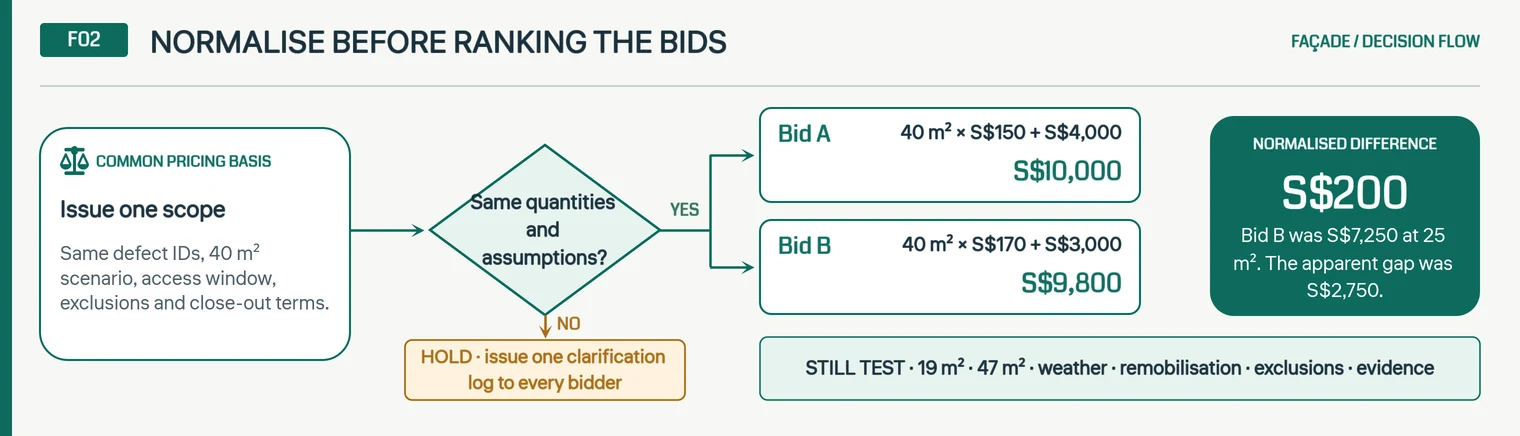
Provide the same marked elevations, defect IDs, photographs and CP or consultant clarifications to every tenderer. Require separate lines for measured quantity, unit rate, access and protection, testing, reporting, provisional items and exclusions. State the assumed access window, working hours, tax basis, tender validity and whether repeat mobilisation is included.
Keep all tender clarifications in one log and issue changed assumptions to every bidder. Where the technical extent is uncertain, identify what is firm, what is provisional and who can confirm it. This prevents a low allowance from being mistaken for a like-for-like fixed price.
Run the same 40 m² scenario through both bids
Bid A prices 40 m² × S$150 + S$4,000 access = S$10,000. Bid B originally prices 25 m² × S$170 + S$3,000 access = S$7,250. Normalising Bid B to 40 m² gives 40 × S$170 + S$3,000 = S$9,800. The apparent S$2,750 gap becomes S$200, but only under the stated assumptions. Obtain written confirmation of rates, access and conditions before relying on the comparison.
Now test sensitivity. Ask what happens at 19 m², at 47 m², after a weather interruption and when a return visit needs new protection. Include testing and location-linked handover records in the comparison. A bid that is cheaper at one quantity may not remain cheaper after the actual access and remeasurement rules are applied.
Put change control into the proposed contract
State who may instruct extra work, how measurements are agreed, how access and time effects are valued and which documents form the final account. BCA’s Public Sector Standard Conditions of Contract (PSSCOC) can illustrate formal change procedures, but they are written for public-sector construction projects and do not automatically govern a private MCST repair. The signed private contract and any expressly incorporated terms control the arrangement. [1]
Practical checklist
- Compare identical defect IDs, quantities and access assumptions.
- Show unit rates, provisional sums, exclusions and tax separately.
- Price a quantity-change and remobilisation scenario, not only the base case.
- Check that handover evidence and technical attendance are included.
Related reading
- When quantities grow on site: how to handle façade repair quantities that change once work starts.
- Pricing the handover pack: what to collect before closing out façade repairs.
- Planning the repair scope: façade maintenance and repair planning.
Scope of this article: The prices in this article are illustrative examples, not market benchmarks. Actual access, quantities, GST treatment and contract terms need project quotations.
References
[1] Building and Construction Authority. (n.d.). Public Sector Standard Conditions of Contract (PSSCOC). Retrieved November 17, 2026, from https://www1.bca.gov.sg/growth-and-transformation/procurement/standard-contract-forms/public-sector-standard-conditions-of-contract-psscoc/
This article is educational background on façade inspection regimes in Singapore. In the strict statutory sense, "façade inspection" means Periodic Façade Inspection (PFI) — the legal requirement under BCA's Building Control (Periodic Inspection of Buildings and Building Façades) Regulations 2021, which must be planned, directed and certified by an appointed Competent Person (CP). Building owners should appoint the required CP under BCA's PFI regime. Facade Inspection Singapore (operated by Ezzogenics) provides contractor-level support — close-range access, rope/height-access, visual and photographic documentation, tapping checks, defect recording, and rectification works — under the CP, consultant or QP's direction where statutory inspection is involved. We do not independently certify statutory PFI compliance or replace the appointed CP unless that role is separately and explicitly agreed.