
Turn the Competent Person’s findings into a traceable action register without confusing urgent safety duties with council procurement dates.
Direct answer: Start with public-risk controls and the appointed Competent Person’s (CP’s) directions. Then assign each defect a named action owner, a decision route, a review date and defined close-out evidence.
What needs action before the next tender cycle?
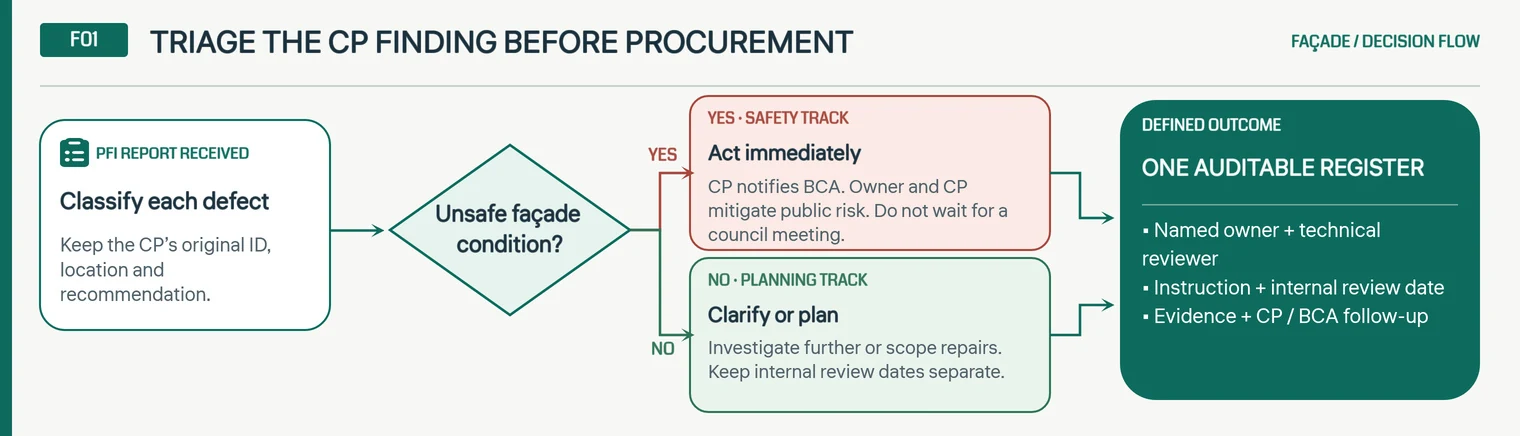
Ask the CP to separate unsafe conditions, findings needing further investigation and defects that can enter planned repair procurement. BCA states that, on identifying unsafe façade defects, the CP must immediately notify the Commissioner of Building Control and work with the owner on measures that mitigate public risk. An MCST meeting, tender or budget approval must not be presented as a reason to delay that response. [1]
Record the protective measure, the person authorised to instruct it, the area controlled and the CP’s next review. Keep this safety track distinct from the commercial track. The two may converge later, but they have different decision tests.
Where the CP considers a full façade investigation necessary to find the cause of a defect, the regulations require the Commissioner’s prior approval before that investigation is carried out, so allow for that step in the register rather than treating it as a procurement delay. [2]
How should the council register be structured?
Use the report’s own defect identifiers and marked elevations. A useful row reads: ‘F-12 · east elevation · level 6 · obtain CP scope clarification · managing agent · review Friday’. Add the report page, photograph, recommended action, dependency and required evidence. If one defect occurs in several places, give every occurrence enough location detail to be priced and inspected separately.
For statutory Periodic Façade Inspection (PFI), the appointed CP conducts the inspection and the current regulations address inspection scope, reporting and façade-inspector duties. Do not rewrite the CP’s technical finding as a council instruction. Place the management action in a separate field so the original meaning remains auditable. [2]
What closes an item properly?
Define close-out when the action is created. Depending on the finding, evidence may include an authorised scope, revised measurements, concealed-work photographs, test records, an inspection acceptance or a CP follow-up. Track BCA directions and statutory commitments separately from internal target dates. Part 5 of the Building Control Act provides the statutory framework; the notice, report and any direction for the building determine the case-specific follow-up. [3]
Practical checklist
- Carry the original defect ID into every quotation, instruction and photograph.
- Name one action owner and one technical reviewer for each item.
- Separate immediate risk controls, investigation, procurement and close-out.
- Escalate any unresolved unsafe condition to the CP without waiting for a routine meeting.
Related reading
- What the CP’s report contains: what goes into a façade inspection report.
- Pricing the repair items: how to compare façade repair quotations for the same defects.
- Closing items out: what to collect before closing out façade repairs.
- Our role around the appointed CP: periodic façade inspection field support and defect mapping and records.
Scope of this article: This article is general guidance. It does not refer to a specific building notice, CP report or BCA direction, so it sets no property-specific statutory deadline or repair priority.
References
[1] Building and Construction Authority. (n.d.). Periodic facade inspection (PFI). Retrieved November 17, 2026, from https://www1.bca.gov.sg/safety-and-standards/periodic-building-inspections/periodic-facade-inspection/
[2] Building Control (Periodic Inspection of Buildings and Building Façades) Regulations 2021 (Singapore), regs. 15–17, 16A–16B. Singapore Statutes Online. https://sso.agc.gov.sg/SL/BCA1989-S785-2021
[3] Building Control Act 1989 (Singapore), Part 5, ss. 26–29. Singapore Statutes Online. https://sso.agc.gov.sg/Act/BCA1989?ProvIds=P15-
This article is educational background on façade inspection regimes in Singapore. In the strict statutory sense, "façade inspection" means Periodic Façade Inspection (PFI) — the legal requirement under BCA's Building Control (Periodic Inspection of Buildings and Building Façades) Regulations 2021, which must be planned, directed and certified by an appointed Competent Person (CP). Building owners should appoint the required CP under BCA's PFI regime. Facade Inspection Singapore (operated by Ezzogenics) provides contractor-level support — close-range access, rope/height-access, visual and photographic documentation, tapping checks, defect recording, and rectification works — under the CP, consultant or QP's direction where statutory inspection is involved. We do not independently certify statutory PFI compliance or replace the appointed CP unless that role is separately and explicitly agreed.