
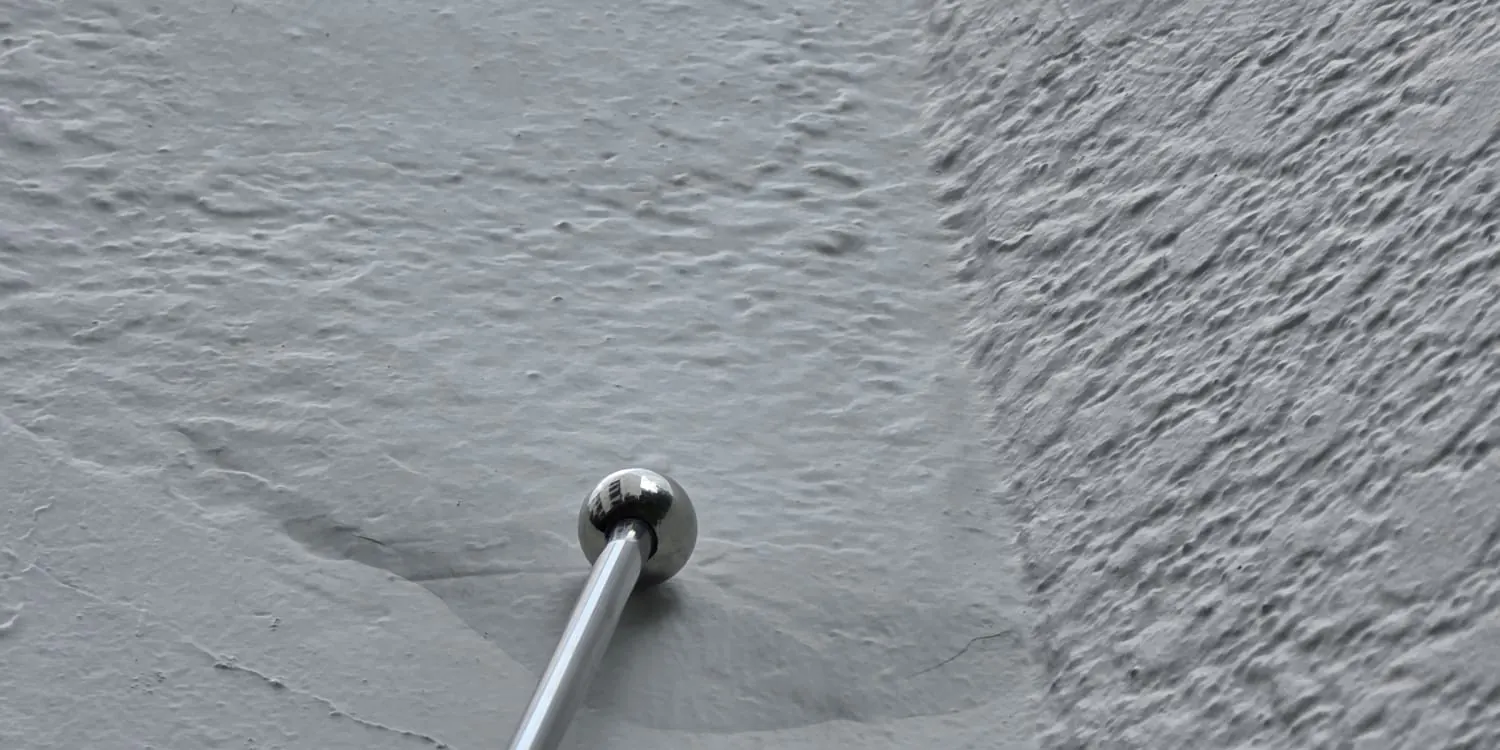
Map the recurrence against the old repair boundary, protect the public where necessary and leave diagnosis to a competent assessment.
Direct answer: Establish whether the new symptom is inside, at the edge of or outside the previous repair. Rebuild the location history and give the appointed professional dated observations, not a premature diagnosis.
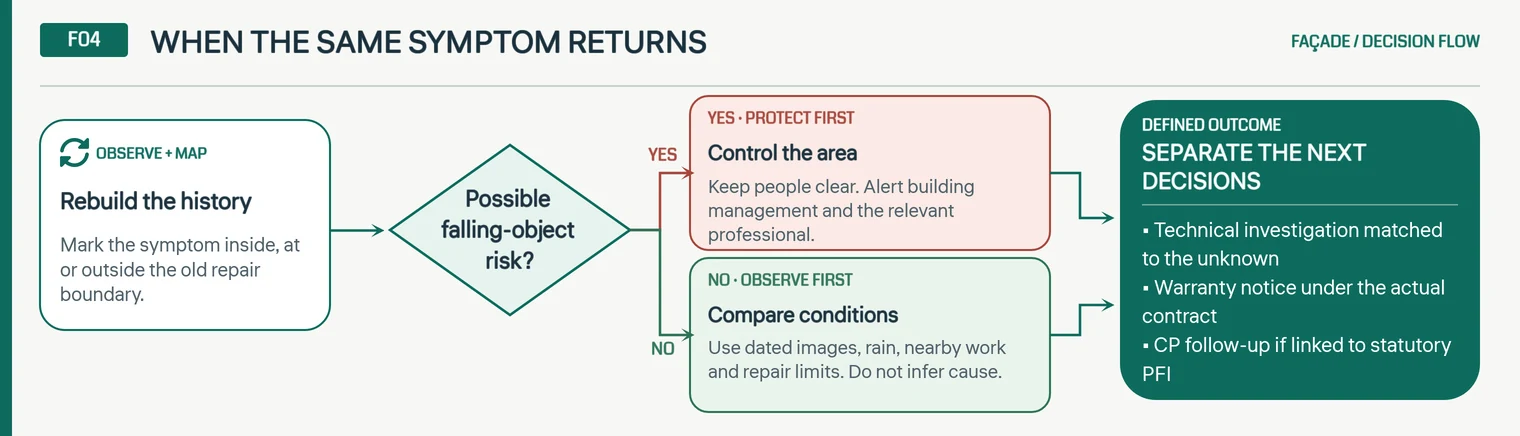
Rebuild the history before choosing a remedy
Retrieve the last marked elevation, defect register, repair photographs, product records and recorded limits of work. From a safe position, take a wide photograph that identifies the level, bay and adjacent windows, then a closer comparison where safely obtainable. Record the report date, first known recurrence, recent rain and nearby work. State explicitly where alignment with the old repair is uncertain.
Compare like with like. A stain photographed after driven rain may not be directly comparable with an old dry-weather image. Note changes in sealant lines, coatings, adjacent fittings and surface damage as observations. Do not infer a concealed water path solely from the visible stain.
Separate safety action, warranty notice and technical review
If an element appears loose or there is a possible falling-object hazard, keep people clear and alert building management promptly. Protective action comes first. In parallel, check the contract for warranty contacts, notice periods and evidence requirements, while arranging the appropriate technical assessment.
Where the issue relates to an ongoing statutory PFI matter, keep the appointed CP informed. BCA’s current PFI guidance and the applicable regulations, not a generic maintenance rule, determine any statutory notification or reporting follow-up. [1] [2]
Match the next investigation to the unanswered question
Ask whether the assessor needs close-range access, a wider inspection area, removal of a finish, moisture investigation or another specialist check. Record the question each step is intended to answer. Update the original defect reference with the second visit, revised extent and decision so that a future team can compare the same location rather than start a new history.
Practical checklist
- Mark the new symptom against the original repair boundary.
- Record weather, timing and adjacent work without treating correlation as causation.
- Control any public-risk area before discussing warranty allocation.
- Define what each proposed investigation is expected to establish.
Related reading
- The records that make a recurrence traceable: what to collect before closing out façade repairs.
- Typical defect families: common façade defects in Singapore buildings.
- When the symptom is a leak: façade water-ingress investigation, with close-range access where needed.
Scope of this article: This article is general guidance. It does not draw on a close-range assessment, moisture investigation or warranty terms for any building, so cause and liability are left open.
References
[1] Building and Construction Authority. (n.d.). Periodic facade inspection (PFI). Retrieved November 17, 2026, from https://www1.bca.gov.sg/safety-and-standards/periodic-building-inspections/periodic-facade-inspection/
[2] Building Control (Periodic Inspection of Buildings and Building Façades) Regulations 2021 (Singapore), regs. 15–17, 16A–16B. Singapore Statutes Online. https://sso.agc.gov.sg/SL/BCA1989-S785-2021
This article is educational background on façade inspection regimes in Singapore. In the strict statutory sense, "façade inspection" means Periodic Façade Inspection (PFI) — the legal requirement under BCA's Building Control (Periodic Inspection of Buildings and Building Façades) Regulations 2021, which must be planned, directed and certified by an appointed Competent Person (CP). Building owners should appoint the required CP under BCA's PFI regime. Facade Inspection Singapore (operated by Ezzogenics) provides contractor-level support — close-range access, rope/height-access, visual and photographic documentation, tapping checks, defect recording, and rectification works — under the CP, consultant or QP's direction where statutory inspection is involved. We do not independently certify statutory PFI compliance or replace the appointed CP unless that role is separately and explicitly agreed.