
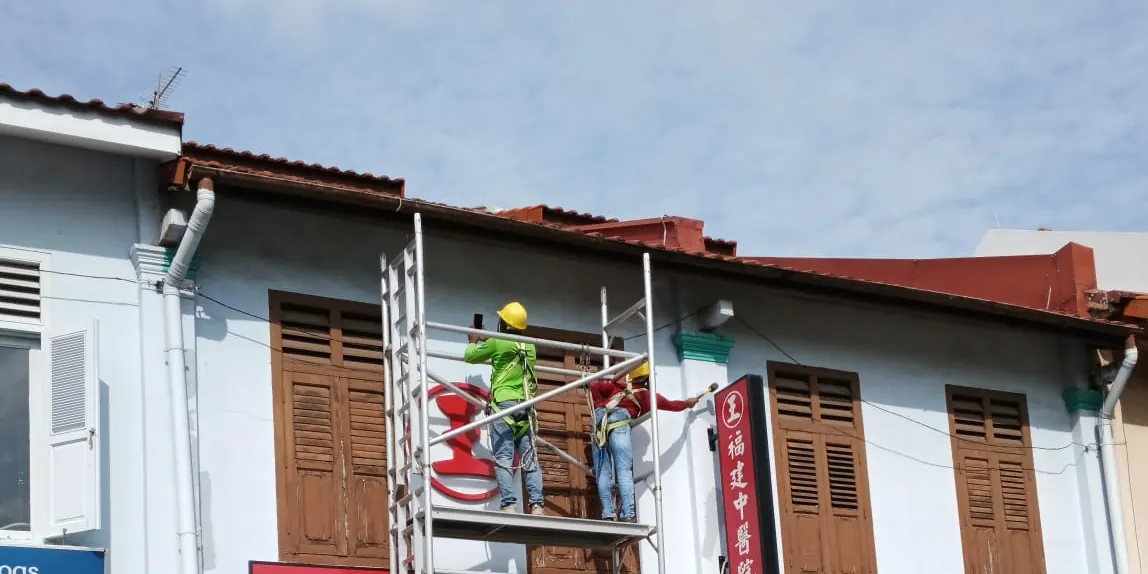
Maintain a fitting-by-fitting register and check licensing, conservation and maintenance responsibility as separate questions.
Direct answer: Record what is attached, where it is, what can be seen safely and who holds its paperwork. Before changing a sign, check both BCA’s licensing route and any URA conservation controls.
Survey fittings without overstating what is visible
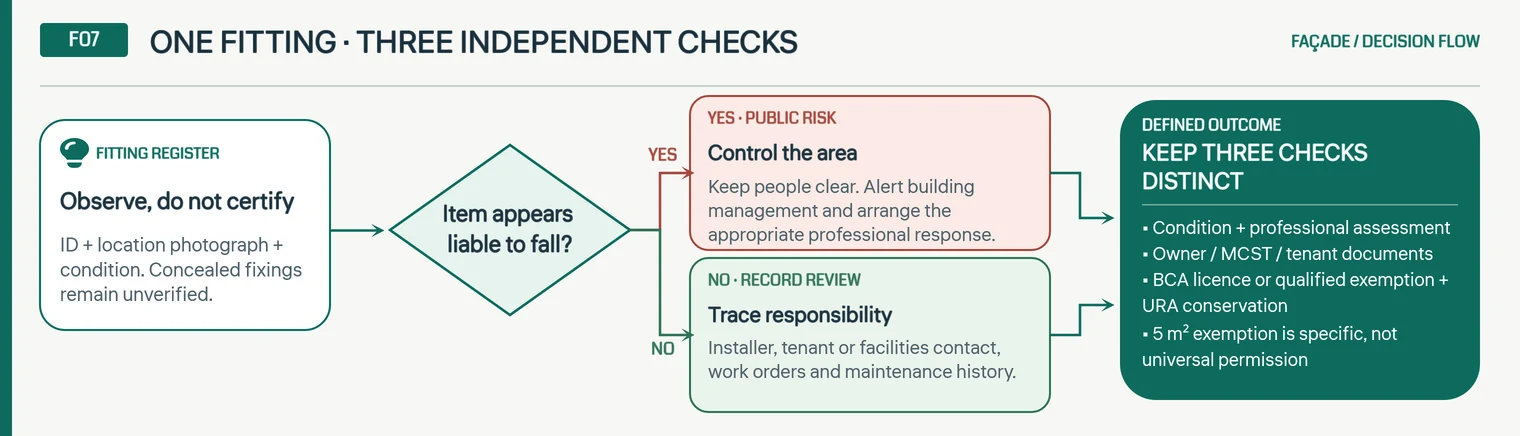
Start above entrances, covered walkways and rear passages. Give every item an ID and pair a wide location photograph with any safely obtainable closer view. Record movement, corrosion staining, missing components, damaged finishes and redundant brackets as observations. If fixings are concealed, say so; do not certify their condition from a ground photograph.
If an item appears liable to fall, keep people clear and inform building management promptly so the appropriate professional and response can be arranged. Record the area controlled and the handover. Avoid turning an uncertain visual observation into a finding about structural adequacy or legal responsibility.
Identify the paperwork and maintenance interface
For each fitting, record the installing party where known, tenant or facilities contact, work orders, maintenance history and any licence, exemption or approval record. At tenancy change, confirm what remains, what will be removed and how redundant fixings or openings will be made safe and repaired. Keep owner, MCST and tenant responsibilities aligned with the actual documents rather than assumed from possession of the fitting.
Check sign licensing and conservation separately
BCA requires a licence to display an outdoor advertising sign or signboard unless an exemption applies. Its published exemptions include a single signboard or a series of related signboards with a total area of not more than 5 m², and its application checklist refers to this as a one-time 5 m² signboard exemption. Do not present ‘under 5 m²’ as universal permission for every sign. Owner or MCST consent, drawings, structural requirements and other clearances may still apply. [1]
In Conservation Areas, URA provides separate siting and design rules and directs signage proposals to BCA’s Advertising Licensing Section. A BCA licensing exemption does not remove URA conservation obligations or any required Conservation Permission for related works. Keep the current photograph, dimensions, location sketch and approval or exemption basis in the fitting register. [2] [3]
Practical checklist
- Give every attachment a unique ID and location photograph.
- Separate visible condition from concealed-fixing verification.
- Record the licence or exemption basis without assuming it transfers to a new sign.
- Check conservation controls before relocation, enlargement or associated alteration.
Related reading
- Preparing the whole frontage: how to prepare for a shophouse façade inspection when the drawings are missing.
- Canopies and other attached elements: cladding, canopy and external screen inspection.
- Getting a closer look safely: close-range inspection access and façade maintenance and repairs.
Scope of this article: This article does not review any specific sign drawings, licences, tenancy documents or concealed fixings, so it does not determine whether any existing fitting complies.
References
[1] Building and Construction Authority. (n.d.). Outdoor advertising sign/signboard licence application. Retrieved November 17, 2026, from https://www1.bca.gov.sg/safety-and-standards/applications-and-licenses/outdoor-advertising-sign-signboard-licence-application/
[2] Urban Redevelopment Authority. (n.d.). Signage guidelines and submission process. Retrieved November 17, 2026, from https://www.ura.gov.sg/guidelines/conservation/signs-in-conservation-areas/
[3] Urban Redevelopment Authority. (n.d.). Conservation guidelines. Retrieved November 17, 2026, from https://www.ura.gov.sg/guidelines/conservation/
This article is educational background on façade inspection regimes in Singapore. In the strict statutory sense, "façade inspection" means Periodic Façade Inspection (PFI) — the legal requirement under BCA's Building Control (Periodic Inspection of Buildings and Building Façades) Regulations 2021, which must be planned, directed and certified by an appointed Competent Person (CP). Building owners should appoint the required CP under BCA's PFI regime. Facade Inspection Singapore (operated by Ezzogenics) provides contractor-level support — close-range access, rope/height-access, visual and photographic documentation, tapping checks, defect recording, and rectification works — under the CP, consultant or QP's direction where statutory inspection is involved. We do not independently certify statutory PFI compliance or replace the appointed CP unless that role is separately and explicitly agreed.